WHEN BUNION SURGERY DOES NOT HEAL CORRECTLY
There are thousands of bunion surgeries done every day, and most patients do very well. Many of the bunionectomy procedures that we do have been done for a hundred years and are well tested. The new techniques are more often concentrating on a minimal incision approach. The older procedures were already done through small incisions, the new techniques rely more on equipment than anything else and unfortunately as you can imagine the less a surgeon can see inside the more possibility of complications occurring. In some cases- bunion surgery can go bad because of surgeon error but that is not very common. In most cases the issues that occur are inherent to any bone surgery especially bone surgery of the big toe joint that bears all of a persons weight when they walk.
WHAT MAKES REVISION BUNION SURGERY DIFFERENT
Why Revision Bunion Surgery Is More Complex Than the First
Revision bunion surgery is NOT simply "doing the surgery again." It is fundamentally more challenging than primary bunion surgery for several reasons:
SCAR TISSUE Your first surgery created scar tissue throughout the soft tissues, joint capsule, and around nerves. This scar tissue distorts anatomy, restricts movement, and makes dissection more dangerous. The surgeon must navigate through distorted tissue while protecting critical structures.
COMPROMISED BLOOD SUPPLY Multiple surgeries can compromise blood flow to the bone and soft tissues. Poor circulation increases the risk of: - Delayed healing - Nonunion - Infection - Avascular necrosis (bone death)
BONE LOSS Failed surgeries often result in bone loss from: - Over-resection during the first surgery - Infection-related bone destruction - Hardware-related bone damage - Nonunion with bone resorption Bone loss may require bone grafting — using your own bone (autograft), donor bone (allograft), or synthetic substitutes.
EXISTING HARDWARE Screws, plates, and pins from the first surgery must be carefully removed. Sometimes they are: - Broken and difficult to extract - Embedded in bone - Causing metallosis (metal particle inflammation) - Infected and requiring complete removal
ALTERED BIOMECHANICS The foot's mechanics have been permanently altered by the first surgery. The surgeon must understand these changes and plan accordingly — often requiring more extensive procedures like: - Joint fusion (arthrodesis) - Tendon transfers - Osteotomies in different locations - External fixation for gradual correction
HIGHER COMPLICATION RISK Revision surgery carries higher risks than primary surgery: - Infection risk increases with each surgery - Nerve injury risk is higher due to scar tissue - Nonunion risk is higher (bone has already failed to heal once) - Stiffness and loss of motion are more common This is why revision bunion surgery should ONLY be performed by surgeons with extensive experience in complex reconstructive procedures.
You can see in the x-rays here , one is before surgery, the white lines show the bunion angle and they are crossing. The red line shows the position on the tendon that we need to realign. The second picture shows the same foot post surgery. you can see the white lines are more in line with each other and the red line shows a tendon which is aligned under the big toe and metatarsal.
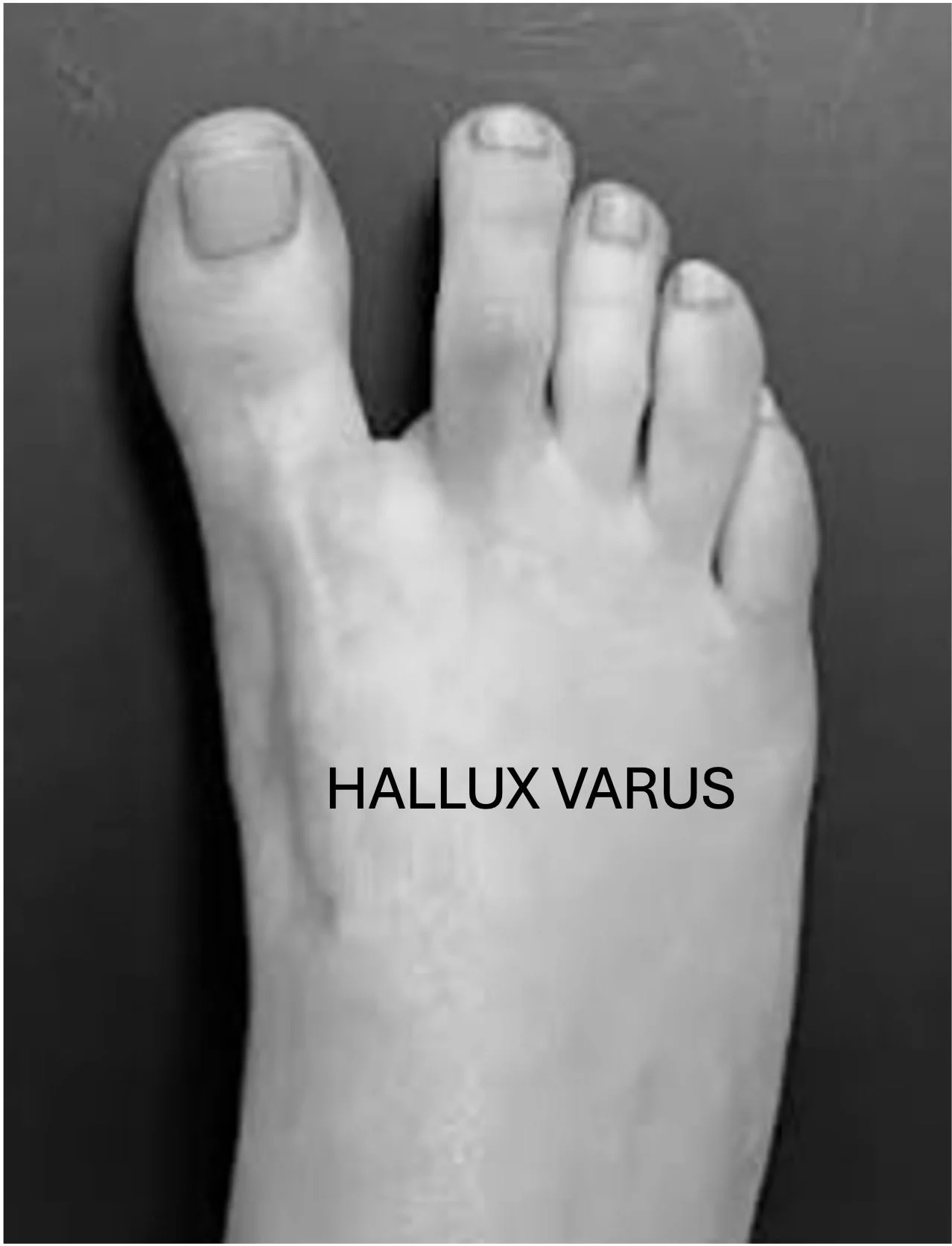
3. YOUR BIG TOE IS DRIFTING THE WRONG WAY If your big toe is angling toward or even crossing over your second toe, the original correction has failed. If it's angling AWAY from your other toes (toward the inside of your foot), you may have hallux varus. This can be for a few reasons - the original surgery “overcorrected” the bunion. Another reason can be that the patients own anatomy, pattern of walking or overall position of the limb forced the big toe into the leaning out position.
10 Warning Signs to Watch For:
Not every ache and pain after bunion surgery means failure. Some discomfort is normal during healing. But certain symptoms are red flags that should not be ignored. Here are the 10 most common signs that your bunion surgery may have failed or developed a serious complication:
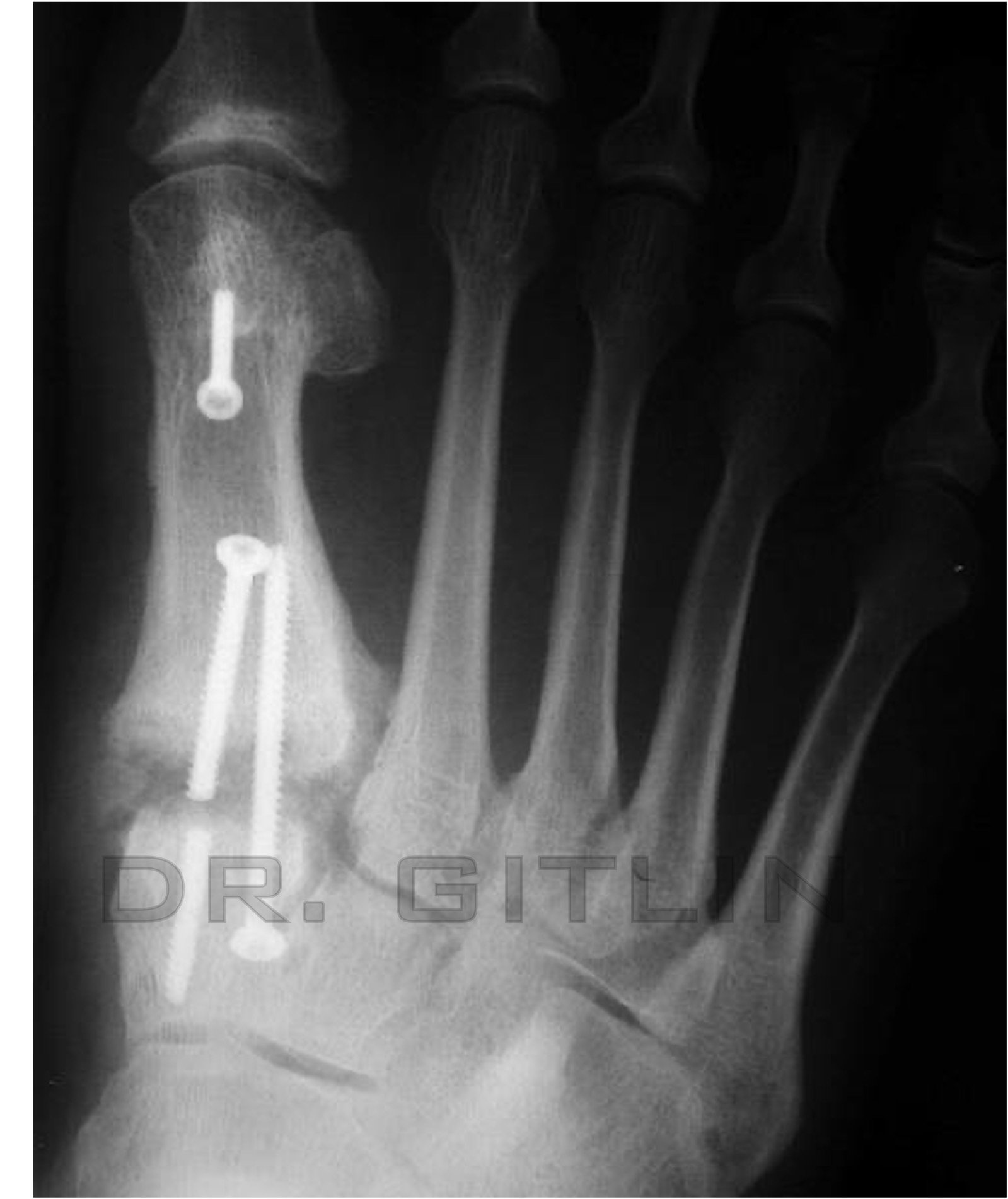
1. THE BUMP IS COMING BACK If the bony prominence on the inside of your foot is visibly returning — especially soon after surgery — this is true recurrence. It means the underlying bone alignment was not adequately corrected, or your foot mechanics are pushing the bones out of position again. Below is a series of X-rays showing before surgery position, after a bunionectomy with a recurred bunion and a post revision X-ray. You can see the revision X-ray shows much more hardware since more work needed to be done to set all the tendons and bones straight.
A bunionectomy procedure does not only shave off a bump, its main function is to realign the tendons so that when those tendons pull on the toe it does not at all lean toward the other toes. In the picture here you can see the yellow arrows showing the tendons positions and which way they pull the big toe. You can see most pull the big toe toward the other toes. When the big toe starts to tilt toward the big toe the bone behind it called the metatarsal bone goes in the opposite way! that bump that occurs on the inside of the foot is what we then call a bunion. The procedure that we choose realigns the pull on these tendons, the key is to weaken the ADD HALL tendons (Adductor Hallucis) and make the FHL ( Flexor Hallucis Longus) in line with the big toe and that big toe should be in line with the metatarsal bone behind it.
4. NUMBNESS, BURNING, OR SHOOTING PAIN Nerve damage affects approximately 3% of bunion surgery patients, with rates as high as 7.5% after simple bunionectomy procedures. The dorsomedial cutaneous nerve — a small nerve on the inner side of the big toe — is especially vulnerable. Damage can cause permanent numbness, burning, or electric shock-like pain.
5. SWELLING THAT NEVER GOES DOWN Some swelling can persist for 6-9 months. But if your foot remains dramatically swollen, red, warm, or tender months after surgery, this could indicate infection, chronic inflammation, or poor circulation.
6. SIGNS OF INFECTION - Fever over 101°F (38°C) - Red streaks extending from the incision - Pus or foul-smelling drainage - Increasing warmth around the surgical site - Wound that won't close or keeps reopening Deep infection can spread to the bone (osteomyelitis), requiring emergency treatment.
7. YOU CAN'T BEND YOUR BIG TOE Stiffness in the big toe joint (hallux rigidus) can develop after surgery due to scar tissue, joint damage, or improper alignment. If you can't bend your toe upward to push off when walking, this severely affects your gait.
8. YOUR SECOND TOE HURTS NOW Pain in the second toe after bunion surgery often means "transfer metatarsalgia" — the first metatarsal isn't bearing weight properly, so pressure has shifted to the smaller toes. This is a sign that the original correction was incomplete or has failed.
9. HARDWARE PROBLEMS If you feel a sharp pain, clicking, or new bump where a screw or plate was placed, the hardware may be loose, broken, or backing out. Hardware failure occurs in a good of minimally invasive bunion surgeries.
Here is an interesting case, the patient had an implant put in for an arthritic bunion, ultimately the implant got infected and failed , he was told an amputation of part of the foot had to be done. We created a new procedure for him where we removed the damaged bone and infected implant, we then moved one bone into the position of the bone we took out. more information on this case click here.
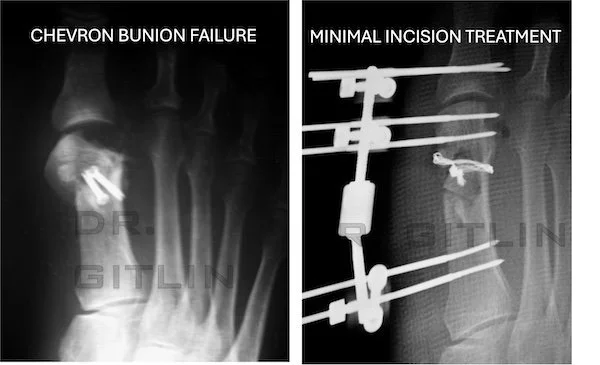
This case shows a chevron bunionectomy ( also called an Austin) where soon after surgery the segment of bone that was moved during the original procedure shifted out of place . If the shift is big enough we can go back into surgery and realign it. Generally in these cases new hardware is placed . Here we used wire and an external fixator to hold the bones together.
10. YOU'RE WORSE OFF THAN BEFORE SURGERY This is the hardest sign to accept. If your foot function, pain level, or quality of life is worse now than before your original surgery, the procedure has failed — regardless of what your original surgeon says.
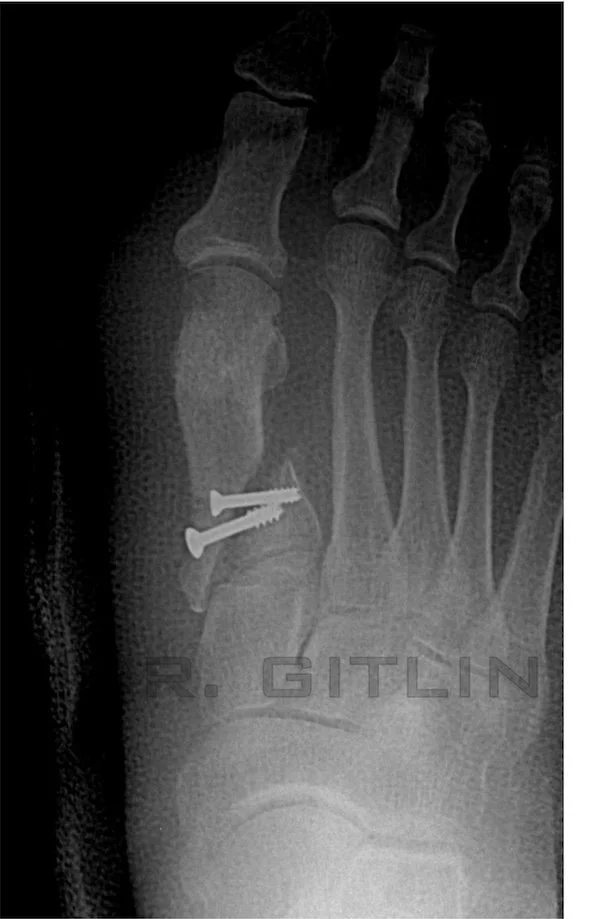
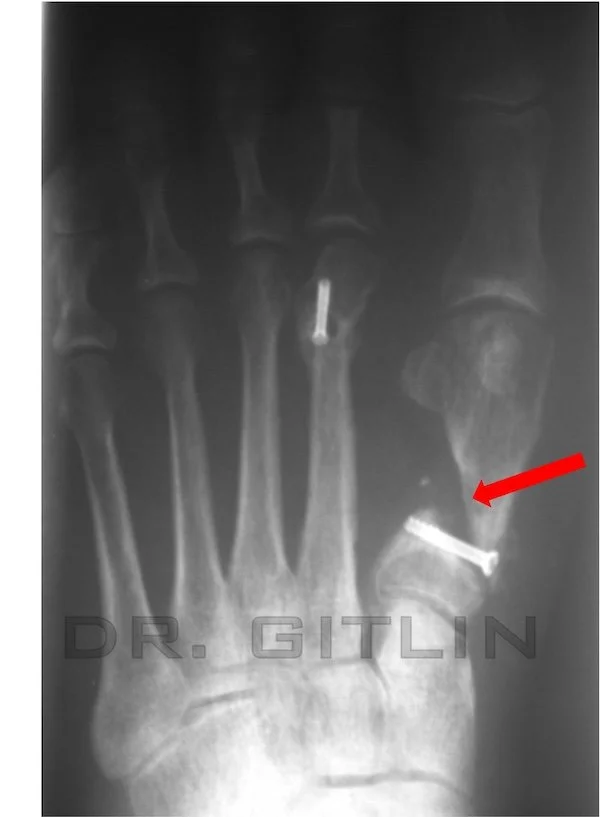
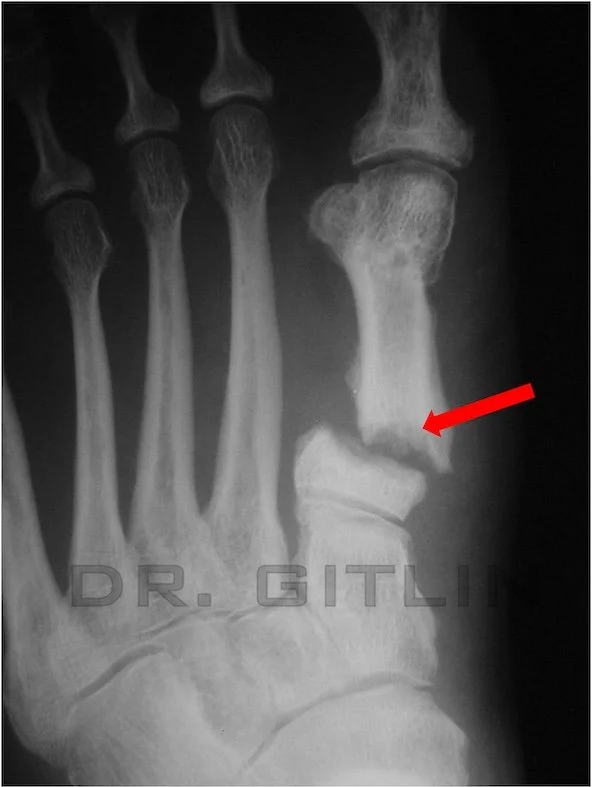
Below are X-rays of a situation called nonunion where the bones do not heal together after surgery. This can cause lingering pain and swelling and need to be carefully assessed. Post operative infections need to be ruled out.
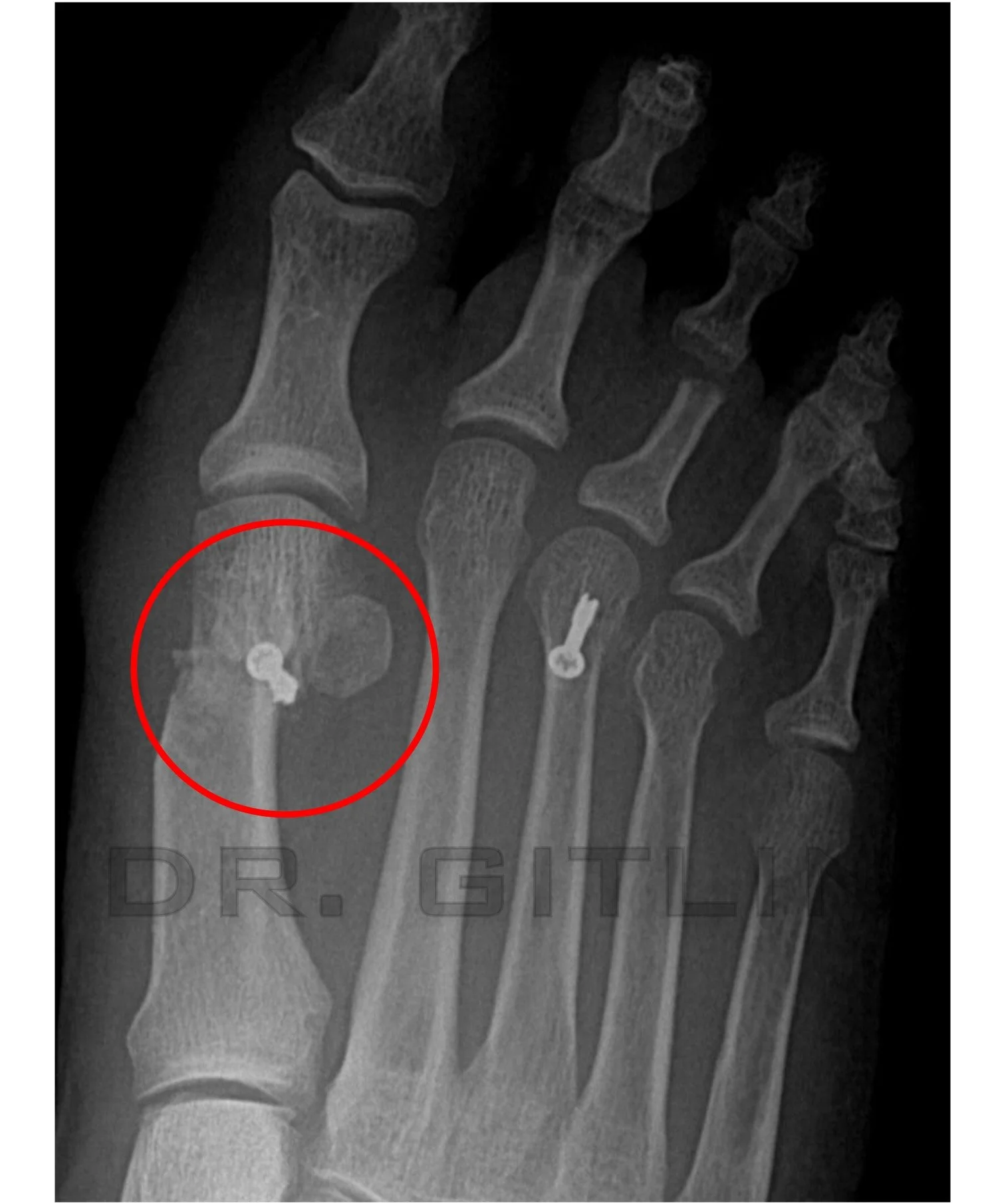
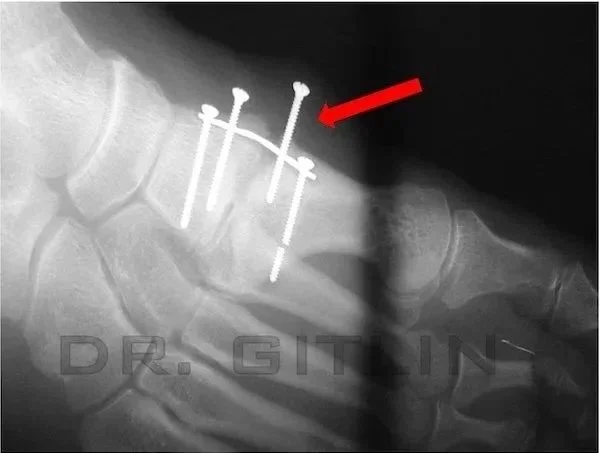
2. PERSISTENT OR WORSENING PAIN (Beyond 2 Months) Some pain is normal for the first few weeks. But if you're still taking pain medication daily at 6 months, or the pain is getting worse instead of better, something is wrong. Possible causes include infection, nonunion (bone not healing), hardware irritation, nerve damage, or arthritis. Below are a few examples of recent cases, a hardware failure where the bone shifted, an X-ray with a nonunion after a lapidus procedure and the photo with the red circle shows a screw that accidentally was placed outside of the bone.
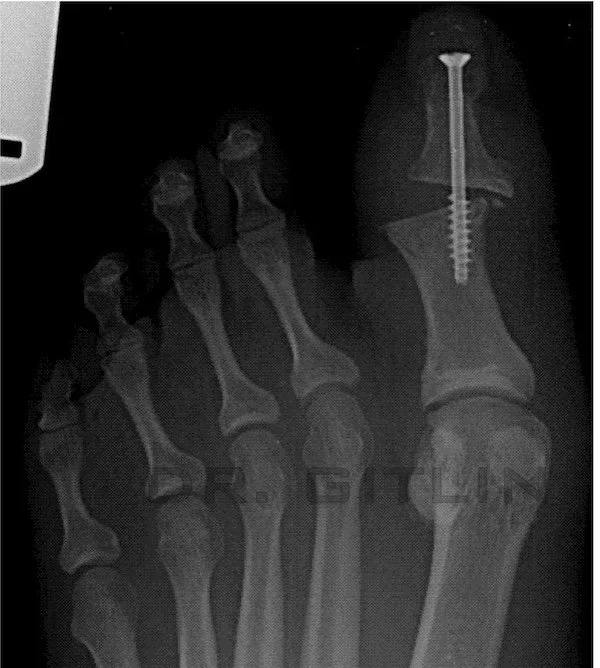
These are x-rays of a case where one angle x-ray looks like a good surgical result, another angle of x-ray showed the bone severely bent downward with the patient having severe pain when walking. Surgery was necessary to correct this and realign the metatarsal bone.
IF YOU NEED HELP OR ADVICE PLEASE CALL US AT 212-372-0991 OR 239-465-0311
OR EMAIL US BELOW AND WE WILL GET BACK TO YOU AS SOON AS POSSIBLE
OTHER CONDITIONS RELATED TO FAILED BUNION SURGERY
IF YOU HAVE QUESTIONS OR WOULD LIKE TO SEE US PLEASE CALL
212-372-0991 OR 239-465-0311