TALUS FRACTURE
Expert Care for Complex Hindfoot Injuries in Florida and New York
The talus is a small but critical bone that sits between the heel bone (calcaneus) and the two bones of the lower leg (tibia and fibula). Because it acts as the "keystone" of the ankle, a fracture here can significantly impact your mobility.
What is a Talus Fracture?
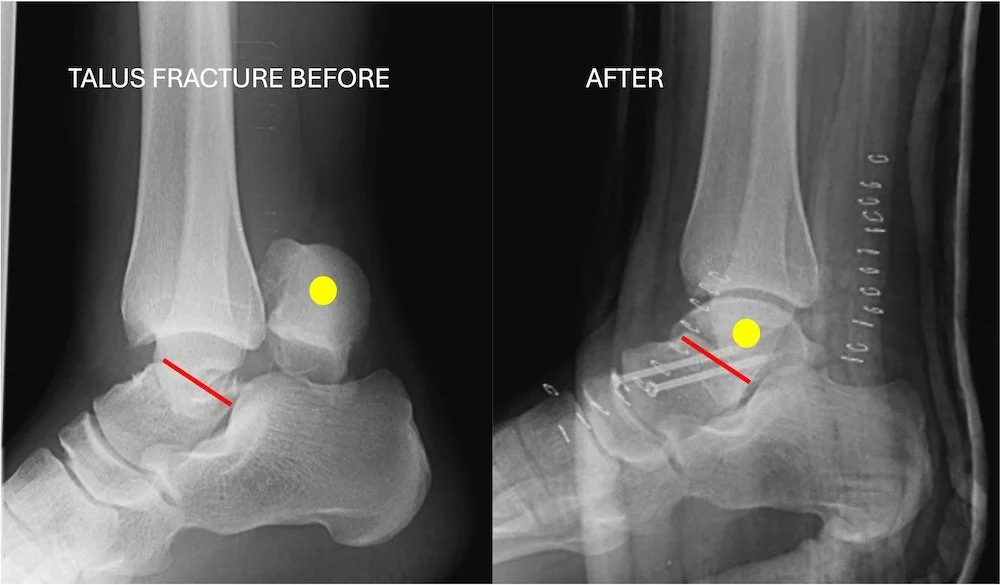
A talus fracture is a break in the bone that makes up the lower part of the ankle joint. Unlike other bones, the talus is 70% covered in articular cartilage and has a limited blood supply. This makes these fractures particularly "high-stakes" injuries that require immediate specialist attention to prevent long-term complications like arthritis or bone death. in the xrays above on the left you see a broken and dislocated talus. The yellow dot shows a bone fragmentclearly not in a correct position. The red line denotes the bone crack ( we call that the fracture line). In the picture on the right you see the bone marked by the same yellow dot back in its normal anatomical position. The red line still shows where the fracture line was. The two screws hold the bone together.
Common Causes and Symptoms
Most talus fractures result from high-energy trauma, such as motor vehicle accidents or falls from significant heights. In some cases, snowboarders may experience a specific break known as a "lateral process fracture."
Signs you may have a talus fracture include:
Acute, intense pain in the ankle or hindfoot.
Inability to bear any weight on the foot.
Significant swelling and bruising (often appearing quickly).
Visible deformity if the fracture is accompanied by a dislocation.
Classifying the Injury: The Hawkins Scale
Surgeons use the Hawkins Classification to determine the severity of a talar neck fracture and the risk of Avascular Necrosis (AVN)—a condition where the bone tissue dies due to lack of blood flow.
Type I: Nondisplaced fracture; low risk of AVN.
Type II: Displaced fracture with subluxation of the subtalar joint.
Type III: Displaced fracture with dislocation of both the subtalar and ankle joints; high risk of AVN.
Type IV: Displaced fracture involving the talonavicular joint.
Advanced Diagnostic Imaging
Standard X-rays are the first step, but because the talus has a complex shape, we frequently utilize Multi-Detector Computed Tomography (CT scans). A CT scan allows us to see the exact degree of displacement and articular involvement, which is essential for surgical planning.
Treatment Options: Surgical vs. Non-Surgical
The goal of treatment is to restore the smooth surface of the joint and ensure proper alignment.
Non-Surgical Treatment
If the fracture is completely stable and nondisplaced (Type I), it may be treated with a cast and a strict non-weight-bearing period of 6 to 8 weeks. Frequent X-rays are required to ensure the bone does not shift.
Surgical Intervention (ORIF)
Most displaced talus fractures require Open Reduction and Internal Fixation (ORIF). During this procedure, we realign the bone fragments and secure them with specialized screws or plates. Because of the tenuous blood supply, we use precise surgical approaches to minimize further disruption to the surrounding tissues.
Recovery and Long-Term Outlook
Recovery from a talus fracture is a marathon, not a sprint.
Non-Weight Bearing: You will typically be off your foot for 8 to 12 weeks.
Physical Therapy: Once the bone shows signs of healing, we begin a structured rehabilitation program to restore range of motion and strength.
Monitoring for AVN: We monitor patients for up to two years post-surgery to watch for signs of avascular necrosis or post-traumatic arthritis.
IF YOU NEED HELP OR ADVICE PLEASE CALL US OR EMAIL US BELOW AND WE WILL GET BACK TO YOU AS SOON AS POSSIBLE
Our Florida and New York Office Locations
NAPLES OFFICE (Gulf Coast)
Serving Southwest Florida, including Fort Myers, Cape Coral, Bonita Springs, and Sarasota.
Address: 3940 Radio Road, Unit 104, Naples, FL 34104
Phone: 239-465-0311
WESTON OFFICE (Atlantic)
Serving the Tri-County area, including Miami, Boca Raton, West Palm Beach, and Hollywood.
Address: Weston near Cleveland Clinic coming soon
Phone: 239-465-0311
NEW YORK CITY OFFICE
Serving New York City and the boroughs as well as the entire Tri-state area
Address: 330 W. 58 street, Unit 610, NYC, NY 10019
Phone: 212-372-0991
OTHER CONDITIONS RELATED TO TALUS FRACTURE
IF YOU HAVE QUESTIONS OR WOULD LIKE TO SEE US PLEASE CALL
212-372-0991 OR 239-465-0311