BRACHYMETATARSIA
Medically Reviewed by Dr. David Gitlin, DPM | Board Certified Foot & Ankle Surgeon | Specialist in Brachymetatarsia Correction & Bone Lengthening | Last Updated: January 2026
Brachymetatarsia is a condition where one or more of the five long bones in the middle of the foot are abnormally short. This can result in the appearance of a significantly shortened toe that is associated with that short long bone. The long bones are called the metatarsals hence brachy which means short plus metatarsal equals short metatarsal. (usually looks like a short fourth toe but can be any toe ) Current medical knowledge tells us brachymetatarsia or brachymetatarsal is caused by trauma to the growth center of the bones during development, some theories suggest it may be a genetic link.
The condition is generally cosmetic but in many cases the patient cannot wear shoegear properly without discomfort and in other cases the ball of the foot may develop tenderness during walking from the altered bone architecture.
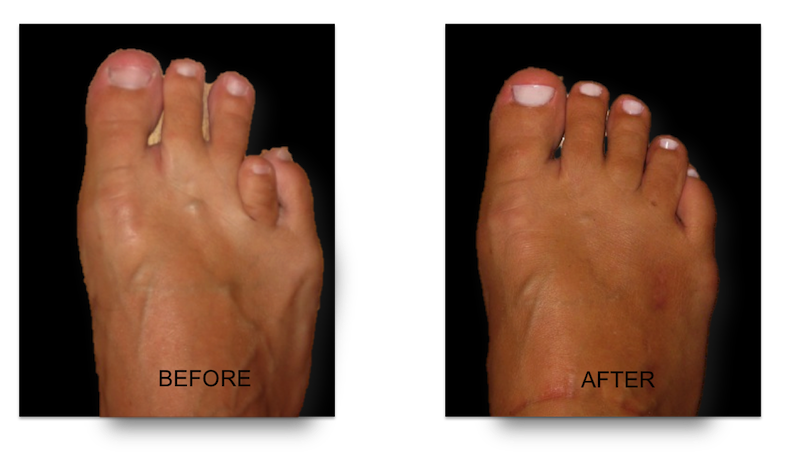
Revision brachymetatarsia cases have been on the rise as well and many patients have been referred and treated here for this as well. Cases of incomplete bone formation or maturation, malunion, nonhealing or incomplete healing. Regenerate bone collapse with shortening of toe. As well as cases of fixator infection and stiff joints all fall into the realm of possible need for revision to get the best result.
Treatments are limited for this condition, conservative treatment simply involves shoegear modification or padding. In most cases however this does not alleviate the problem. Surgical intervention is often necessary to correct the condition.
Generally these are divided into one stage procedures and gradual lengthening procedures. The one step lengthening involves in some cases shortening all the other adjacent metatarsals and elongating the brachymetatarsal by cutting and placing bone graft into it. As you can imagine this leaves excessive scarring to the foot and makes it difficult to achieve the exact length needed. It is very difficult to stretch out the tendons ligaments and surrounding soft tissues when the digit has been in that position from an early age.
This can also be increasingly painful since all of the nerves are stretched as well during the procedure. Also the patient is not allowed to weight bear on the limb for up to 3 months.
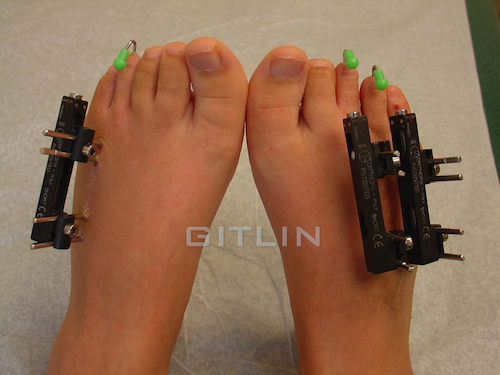
The gradual lengthening procedure involves using minimal incision surgery to cut the short metatarsal and to apply a titanium metal external fixator rail to the foot. This external scaffold sits on the outside of the foot and allows the doctor and patient to gradually make that metatarsal longer through distraction osteogenesis.
Ilizarov surgery is where we grow new bone - this is a technique where the bone is stretched out at a very particular speed that allows the bone to regenerate itself. There is no need for bone grafting.
Weight bearing in a special comfortable shoe is allowed and encouraged to promote faster and stronger bone healing. To learn more about the technique see the case presentation below. To see some other cases treated with the ilizarov distraction technique .
Our office also provides revisional surgery for failed brachymetatarsal surgery done elsewhere. Unfortunately these situations do occur at no fault of anyone since all people heal differently but we do have a variety of techniques to repair nonunions, regenerate fractures, malunions, toe joint stiffness, and joint contracture problems associated with brachymetatarsia correction.
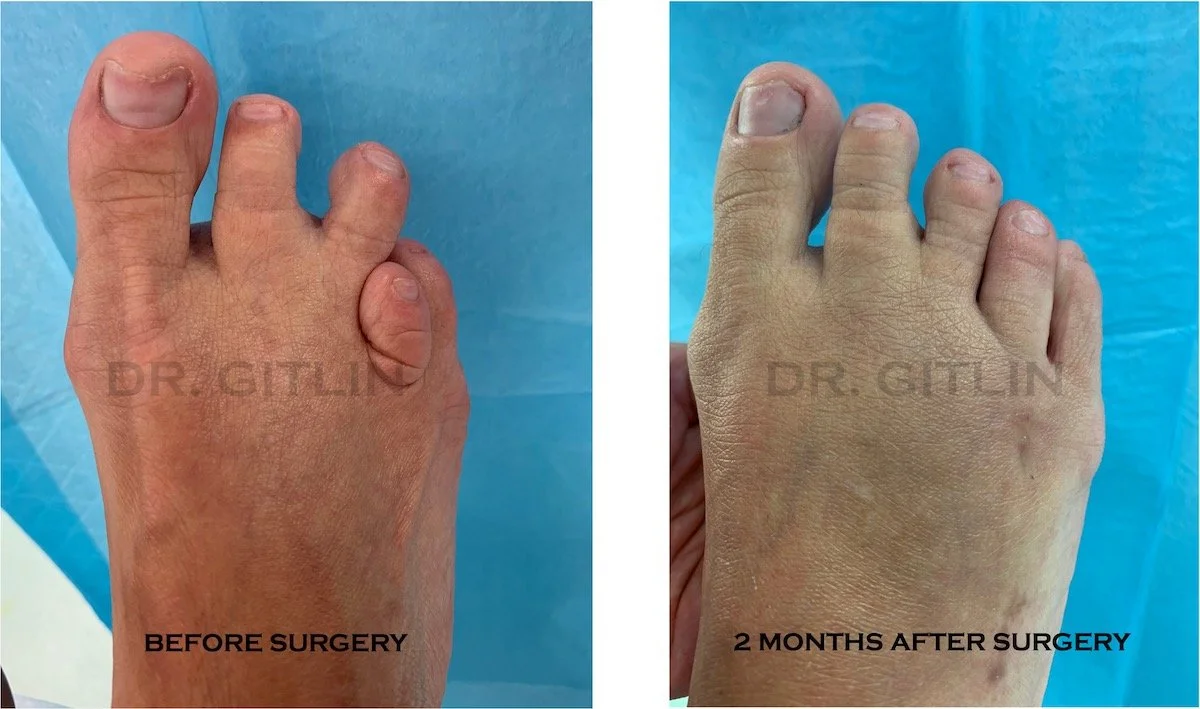
The ‘MOST IMPORTANT’ things you need to know :
If you are having Brachymet surgery ( short toe) here are the questions you have to ask your surgeon:
1. Do you let your patients weight bear immediately after the procedure?
What you need to hear is yes, immediately , you should be able to walk out of the hospital the day of surgery, bearing weight is an important part of growing new regenerate bone. If the doctor tells you that you need to off your foot for a portion of the treatment or for the entire treatment - find another doctor.
2. Do you make a long incision or do you put fixator wires in percutanously ( through skin with no incision ) ?
What you need to hear is - yes the wires are placed percutanously, and the incision for the bone cut in only a few millimeters long.
You have probably already searched the internet for pictures of feet before and after - if you see a long incision scar that is not appropriate technique. The best way to regenerate bone and heal it is to minimize disruption of the tissues; open incisions scar all the surrounding tissues where you need them most for bone healing.
If the surgeon makes a long incision - definitely find another doctor.
3. How often do you have to take patients back to surgery to bone graft?
What you want to hear is almost never. In our practice we have never taken a patient back to surgery for grafting... ever. WHY? Because we very carefully monitor bone healing and see our patients weekly during the growth phase of bone. If its often they need to graft - find another doctor.
4. How often do i need to see the doctor?
What you want to hear is every week for the first few weeks after surgery and during the bone growth phase. Why? If an experienced doctor monitors the growth of bone, small adjustments can be made to control it carefully.
If the doctor is not interested in careful monitoring especially at the beginning of the post operative period - find another doctor.
5. Will i see the actual surgeon for post operative visits or an assistant?
I would think you would want to hear yes, you see the surgeon who performed your procedure at every visit. If not I would think about finding another doctor.
If you have any questions please email Dr. Gitlin from the contact us page.
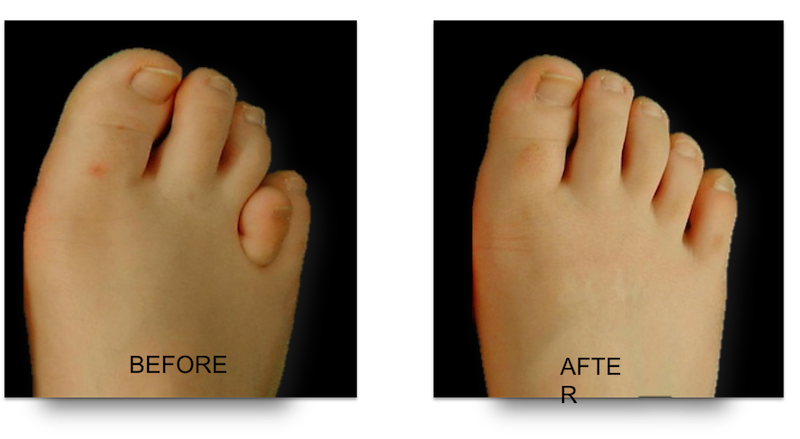
And now a bit about us:
Dr. Gitlin has lectured nationally on the topic of Brachymetatarsia correction over the past 25 years. We have adopted new techniques based on extensive experience that keep incisions minimal ( usually only a few millimeters ) and all of our patients can walk on the surgical foot the day of surgery. Not only do we use those new techniques but we base our treatment on classic teachings of ilizarov ( the doctor who invented the technique of distraction osteogenesis - growing bone by stretching it out ). Techniques that have been tested and proven over the last 60 years in tens of thousands of cases. Dr. Gitlin has been translating journals and technical books from the Ilizarov hospital since his first trip there in 2002, gaining valuable insight on even the minute nuances that we now use for attain the most positive results for our patients.
Below is a case of a 35 year old female who underwent two failed attempts at brachymetatarsia correction. She came to us for revision, we then performed a metatarsal lengthening with gradual correction that enabled us to fix the nonhealing bone from the last surgery and a skin procedure was done to help pull the toe down. the postoperative picture is on the right.

Yes we can do both feet at the same time but it is not optimal for bone healing. All of our patients weight-bear immediatly after the surgery, this actually aids in quicker bone regeneration and healing time, when both feet are operated on patients simply cannot control the amount of weight they put on their feet, healing can be compromised. On the other hand we routinely do multiple metatarsals during the same surgery like on the right foot below.
Below is a case of brachymetatarsia of the first metatarsal. Next to a short fouth toe and metatarsal this seems to be the most common type that we have seen. Xray in the middle shows the barely visible regenerate bone , look closely you can make out the bone shape.

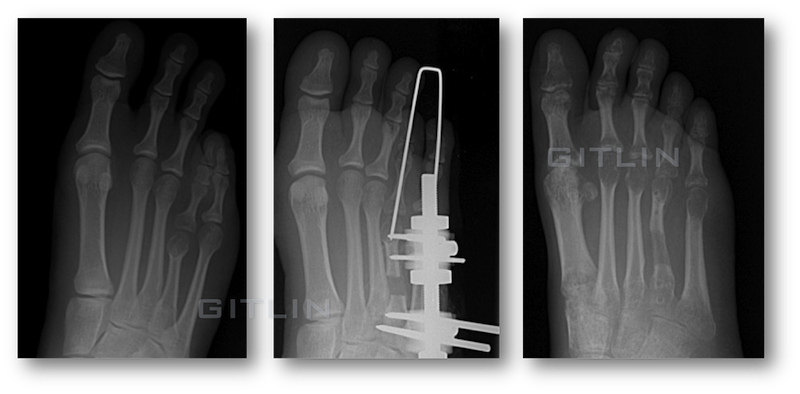
Below we see xrays of the process, on the left is a typical before surgery xray of a brachymetatarsia condition. The center image is during the lengthening, here you can see the bone regenerate in the middle of the bone. You can also see the xray of the metal external fixator with pins holding it onto the metatarsal bone. On the right is a final xray you can see the solidifying regenerate.
Below is another case the post operative picture on the right shows minimal scarring, what is there can be treated with an over the counter scar treatment with excellent results.


And another case……..

Another case........Of a 15 year old female with brachymet ( short fourth toe)...

Another case pre operative picture on left , postoperative ( 10 weeks later) on right with minimal scarring. In this case we also corrected a mild bunion deformity hence the scar over big toe joint.

and another case...... preop on left, post op on right

Here is a case of Brachymetatarsia of both the 4th and 3rd toes, both were lengthened at same time. The post operative photograph on the right was taken 9 weeks after the surgery

Below, another case : here pre-op brachymetatarsia and bunion on left, post op on right after both short toe and bunion fixed. Still a bit swollen but picture taken just nine weeks after actual surgery. So swelling is normal at this stage of healing.

FREQUENTLY ASKED QUESTIONS :
What causes Brachymetatarsia?
Brachymetatarsia (also called brachymetatarsal) is a condition where one of the metatarsal bones in the foot is abnormally short, most commonly the fourth metatarsal, which makes the fourth toe look short or “stubby.” It is usually caused by early closure or damage to the growth plate during development, and can sometimes be related to trauma, genetics, or other medical conditions. Many patients first notice brachymetatarsia as a cosmetic problem, but it can also cause pain in the ball of the foot, difficulty fitting into shoes, and problems with walking or sports.
Is brachymetatarsia just a cosmetic problem, or can it cause foot pain?
Brachymetatarsia is often first noticed because of the cosmetic appearance of a short toe, especially the short fourth toe in women who wear open shoes or sandals. However, the condition can also be functional and painful. The shortened metatarsal changes how weight is distributed across the ball of the foot, which can lead to transfer metatarsalgia, calluses, tenderness under the neighboring metatarsals, and difficulty wearing normal shoes. Many patients seek brachymetatarsia correction surgery for a combination of cosmetic concerns and pain relief.
What is the difference between one‑stage brachymetatarsia surgery and gradual lengthening?
One‑stage brachymetatarsia correction involves a single operation where the short metatarsal is lengthened with a large bone graft and sometimes shortening of neighboring metatarsals. This often requires a long incision, more soft‑tissue stretching, more post‑operative pain, scarring, and a longer period of non‑weight‑bearing. Gradual metatarsal lengthening uses a minimally invasive cut and an external fixator to slowly lengthen the bone over time. With distraction osteogenesis, the body grows its own new bone without grafts. In our experience, gradual lengthening for brachymetatarsia offers better control of the final length, smaller scars, immediate or early weight‑bearing, and less risk of complications such as nonunion and regenerate collapse.
What is revision brachymetatarsia surgery and can a failed short toe surgery be corrected?
Revision brachymetatarsia surgery is performed when a previous short toe operation has not healed properly or has left the metatarsal too short, painful, or deformed. Failed brachymetatarsia surgery can involve problems such as nonunion (bone not healing), malunion (bone healed in the wrong position), regenerate collapse, stiffness or contracture of the toe joint, infection, or prominent scars and hardware. Our office frequently treats revision brachymetatarsia cases from other centers using advanced Ilizarov‑based techniques, external fixators, bone regeneration, soft‑tissue procedures, and careful post‑operative monitoring to restore metatarsal length, improve alignment, and reduce pain where possible.
At what age can brachymetatarsia be treated, and is there an ideal time for surgery?
Brachymetatarsia can be evaluated in childhood, adolescence, or adulthood. In many cases, we prefer to wait until the growth plates in the foot are nearly closed (often in the mid‑teenage years) before performing metatarsal lengthening, to avoid interfering with normal growth. Adult patients of many ages can still successfully undergo brachymetatarsia surgery. The ideal timing depends on the severity of the short toe, symptoms, shoe‑wear problems, activity level, and emotional or cosmetic concerns. A thorough evaluation and X‑rays are needed to decide the best time for each individual patient.
IF YOU NEED HELP PLEASE CALL US OR FILL OUT THE FORM BELOW
OTHER CONDITIONS RELATED TO BRACHYMETATARSIA
IF YOU HAVE QUESTIONS OR WOULD LIKE TO SEE US PLEASE CALL
212-372-0991 OR 239-465-0311